
Hydrogen Embrittlement and Delayed Fracture in Fasteners
Executive Summary
Hydrogen embrittlement and delayed fracture is the most concealed failure mode in high-strength fasteners, often striking weeks or months after assembly. Based on GB/T 3098.17-2022, this article works through the mechanism, the high-risk processes, the identification methods and the prevention measures that help manufacturers eliminate the risk at source.
Table of Contents
In the production, processing and application of high-strength fasteners, hydrogen embrittlement and delayed fracture is one of the most concealed and destructive failure modes. Fracture often occurs hours, weeks or even months after assembly, with no obvious warning, and routine quality inspection cannot catch it in advance. At best it causes equipment failure; at worst it triggers a safety accident. For 8.8 grade and above high-strength fasteners the risk rises sharply, which has made hydrogen embrittlement a core control point in high-end manufacturing supply chains.
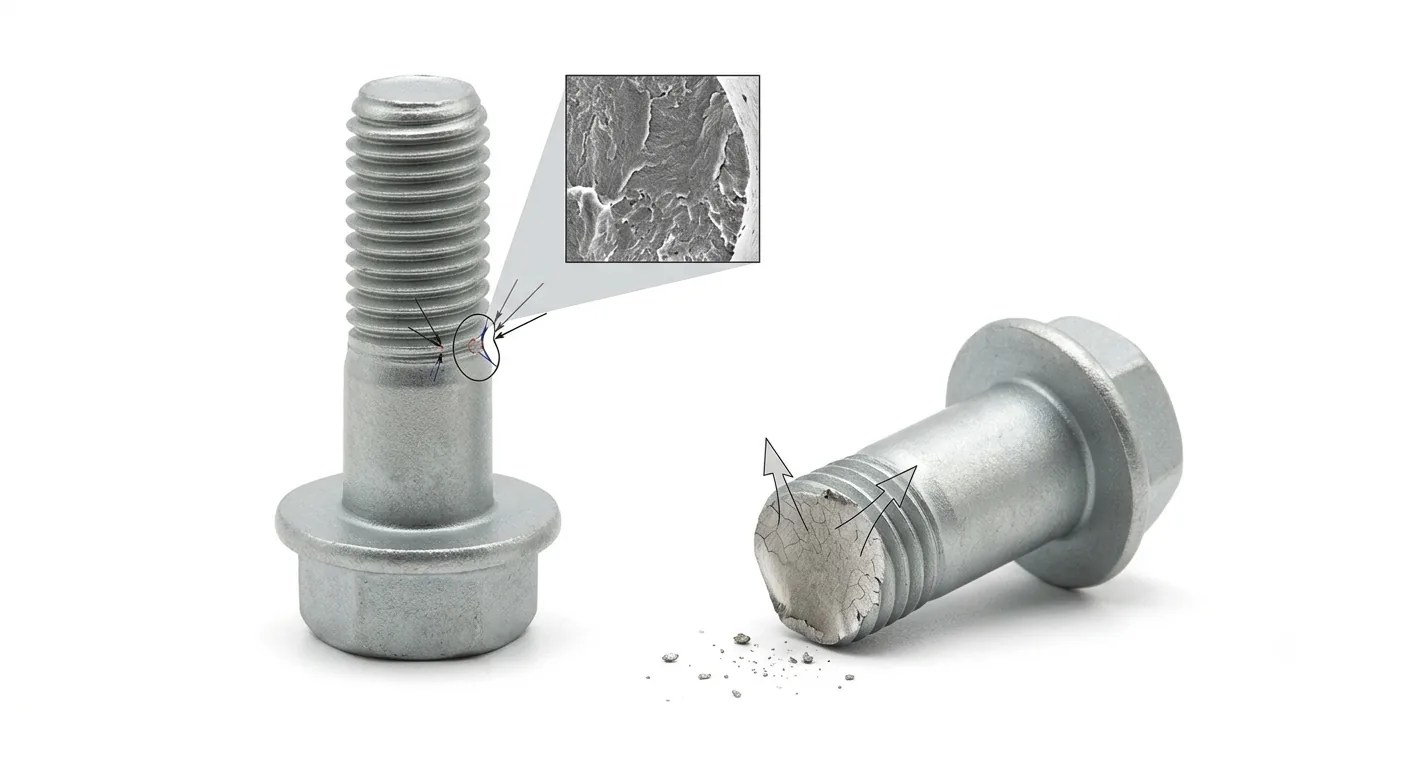
Drawing on GB/T 3098.17-2022, the national standard for mechanical properties of fasteners and hydrogen embrittlement testing of bolts, screws and studs, and on YF Zhichengjia's process control experience in high-strength fastener production, this article explains the formation mechanism, high-risk processes, identification methods and scientific prevention strategies for hydrogen embrittlement and delayed fracture, helping companies eliminate the risk at source and keep bolted joints safe and reliable.
1. Core Concepts: The Nature and Cost of Hydrogen Embrittlement and Delayed Fracture
Hydrogen embrittlement refers to the absorption of hydrogen atoms by a metal during specific processes; the atoms diffuse through the material and accumulate at grain boundaries or defects, causing brittle fracture under stress. Its core characteristics and consequences are as follows:
1. Core characteristics: first, delay. Fracture does not occur immediately but after an incubation period following assembly, then is triggered suddenly by stress. Second, suddenness. There is no visible plastic deformation before fracture, so it cannot be predicted by eye. Third, irreversibility. Once the material has absorbed hydrogen atoms they cannot be fully removed by simple subsequent treatment; only specific processes can reduce the risk.
2. Core consequences: hydrogen embrittlement fractures mostly occur at critical joints in high-strength fasteners, such as automotive engine bolts, wind turbine flange bolts and aerospace fasteners. Once they fail, equipment downtime, product recall and even personal injury can follow. Industry statistics show that domestic recalls of automotive fasteners caused by hydrogen embrittlement grew 37% year on year in 2023, with average losses per event above one million yuan; the cost cannot be ignored.
3. High-risk objects: GB/T 3098.17-2022 specifies that medium- and high-carbon steel and alloy steel fasteners with tensile strength of 1000 MPa or more (8.8 grade and above) are the high-risk category for hydrogen embrittlement and delayed fracture. Ordinary-strength fasteners such as grade 4.8 have higher material toughness, so their risk is very low and dedicated prevention is usually unnecessary.
2. Root Causes: The High-Risk Process Steps
Hydrogen embrittlement is not caused by a single factor; it is the combined effect of hydrogen absorption and stress triggering. The hydrogen atoms come mainly from two key processes in fastener production, which are also the focus of prevention. Drawing on industry practice, they are analysed below:
1. Pickling and descaling (one of the main hydrogen sources)
To remove oxide scale and rust from the surface of raw material, fasteners are pickled, commonly in hydrochloric or sulfuric acid solution. During pickling the cathodic reaction generates large amounts of hydrogen atoms, some of which penetrate the metal matrix. Poor process control leads to excessive absorption:
Pickling liquor that is too concentrated, or pickling that runs too long, intensifies hydrogen generation and increases the amount that penetrates;
Insufficient or spent inhibitor in the pickling bath fails to suppress hydrogen penetration, sharply raising the risk of embrittlement;
If parts are not rinsed and dried promptly after pickling, residual acid keeps generating hydrogen atoms and aggravates the problem.
2. Electroplating (the main hydrogen source)
Whether conventional zinc electroplating or environmentally friendly trivalent chromium zinc plating is used, hydrogen evolution occurs at the cathode, which is the fastener, during electrolysis, and the hydrogen atoms produced readily penetrate the high-strength steel matrix. This is the primary cause of hydrogen embrittlement. A common industry misconception holds that environmentally friendly zinc plating is safe enough; in fact trivalent chromium zinc plating still carries a hydrogen embrittlement risk of about 15%, far above the safety threshold.
In addition, if passivation after plating is performed at the wrong time it closes the diffusion paths for hydrogen atoms, so absorbed hydrogen cannot escape and the risk actually increases. This is a detail many companies overlook.
3. Stress triggering (the necessary condition for fracture)
Absorbed hydrogen alone is not enough to cause fracture; a stress trigger is also required. Common sources include:
Preload stress: the clamping force applied during assembly, especially when it is high (approaching or exceeding 70% of nominal tensile strength), provides the driving force for hydrogen accumulation and crack growth;
Processing stress: internal stress from cold heading, cold drawing and thread rolling, if not fully relieved by tempering, becomes the initiation site for hydrogen-induced cracks;
Service stress: alternating and vibration stress in use accelerates hydrogen diffusion and crack propagation, triggering delayed fracture.
3. Identifying the Risk: Methods in the GB/T Standard
To identify hydrogen embrittlement risk accurately and keep non-conforming parts out of the market, testing should follow GB/T 3098.17-2022, combining laboratory methods with simple field checks to cover the whole process:
1. Laboratory testing
The core method specified by GB/T 3098.17-2022 is the delayed fracture test. The procedure is as follows:
Sample preparation: random samples are taken from each batch of high-risk fasteners and must pass through the same pickling, plating and heat treatment as actual production, so that the results reflect reality;
Loading: dedicated equipment applies a constant load equal to 90% of yield strength, simulating preload stress in service;
Observation and verdict: samples are observed for 200 hours. If none fractures, the batch passes; if any fractures within 200 hours, the batch exceeds the risk limit and must be reworked or scrapped in full.
Metallographic analysis can also be added, to observe hydrogen accumulation and micro-cracks inside the fastener and support the risk assessment.
2. Simple field checks
On the production floor and at the point of use, high-risk fasteners can be screened quickly against three points:
Material and strength: fasteners with tensile strength of 1000 MPa or more (8.8 grade and above) made of medium- or high-carbon steel or alloy steel are all high-risk objects;
Process signature: fasteners that have been pickled and electroplated (especially zinc plated) without a proper dehydrogenation bake carry a very high risk;
Application: fasteners used in safety-critical locations such as engines and braking systems, in non-detachable structures, or under vibration and alternating loads deserve priority screening.
4. Prevention Across Production and Application
Drawing on GB/T 3098.17-2022 and YF Zhichengjia's production control experience, the following measures are practical and can be implemented along three lines: control hydrogen at source, remove it in process, and verify it at the end.
(1) Control at source: optimise processes to reduce hydrogen absorption
1. Optimise pickling: strictly control concentration and time, with hydrochloric acid at 15%-20% and sulfuric acid at 20%-25%, and pickling time adjusted to part size (typically 5-10 minutes). Add sufficient inhibitor to the bath to suppress hydrogen generation and penetration. Rinse three times immediately after pickling to remove residual acid, then dry quickly.
2. Choose surface treatments with no hydrogen risk: for 8.8 grade and above, prefer processes that do not evolve hydrogen, eliminating absorption at source. Two are recommended:
Zinc-nickel alloy plating: the nickel addition forms a dense alloy layer that blocks hydrogen diffusion, keeping embrittlement risk below 1% while giving excellent salt-spray resistance (200-1000 hours), in line with ASTM F1940;
Zinc flake coating: a non-electrolytic coating process with no hydrogen evolution at any stage, eliminating the risk entirely. It suits ultra-high-strength fasteners (10.9 and 12.9 grade) and withstands more than 720 hours of salt spray.
Note: conventional zinc plating, colour zinc plating and similar processes are not suitable for 8.8 grade and above and must be avoided.
(2) In-process removal: bake to drive out absorbed hydrogen
Where customer requirements or production constraints make a hydrogen-evolving process such as zinc plating unavoidable, a proper dehydrogenation bake must be carried out within 4 hours of plating. This is the key step in reducing risk; the requirements are as follows:
Baking temperature: 190–220 °C. Too high affects the mechanical properties of the fastener; too low fails to drive hydrogen out effectively;
Baking time: no less than 8 hours, extended by 1 hour for every additional 1 mm of section thickness, so that hydrogen deep in the matrix escapes fully;
Critical rule: do not passivate before baking, because passivation seals the diffusion paths so hydrogen cannot escape and the risk increases. After baking, cool slowly to avoid introducing new internal stress.
(3) Final inspection: test to standard and ship nothing non-conforming
1. Test every batch: for 8.8 grade and above, run the delayed fracture test to GB/T 3098.17-2022 on every batch, and never release a non-conforming batch;
2. Add complementary checks: hardness testing and metallographic analysis catch risks arising from process deviation and confirm that mechanical properties and internal quality meet specification;
3. Build process traceability: record pickling, plating and baking parameters for every batch, so that any field failure can be traced quickly to its root cause and the process corrected in time.
(4) Application: assemble correctly to limit stress triggering
1. Control preload: set preload sensibly in accordance with GB/T 3098.1-2010 and avoid excessive preload (not above 70% of nominal tensile strength), reducing the risk of stress-triggered embrittlement;
2. Relieve assembly stress: before assembly, low-temperature temper the fasteners to remove internal stress from cold working and transport;
3. Avoid aggressive environments: in damp, saline, acidic or alkaline conditions, apply additional corrosion protection so that corrosion-induced stress does not combine with hydrogen and accelerate fracture.
5. Conclusion
Hydrogen embrittlement and delayed fracture is the silent killer of high-strength fasteners. Prevention centres on controlling hydrogen at source, removing it in process and verifying it at the end, in strict accordance with GB/T 3098.17-2022, together with optimised production processes, disciplined testing and sensible stress control at the point of use. Leading manufacturers such as BYD, GAC and Midea now make a hydrogen embrittlement test report a mandatory condition for supplier approval, and prevention has become a hard entry threshold for high-end supply chains.