
Special Surface Treatments for Fasteners: Nine Coating Technologies
Executive Summary
Fasteners are the basic connecting element of machinery, automobiles, wind turbines and precision instruments. Their service life, stability and safety do not depend solely on the base material: the surface treatment is what actually determines resistance to corrosion, wear, friction, high temperature and thread galling. This article explains the nine most widely used special coating technologies, one by one.
Table of Contents
- 1. LC coating (organic composite dry film: insulation and precision torque stability)
- 2. DLC coating (hard vacuum carbon film: ultra-high wear resistance, low friction)
- 3. PVD coating (physical vapour deposition: superhard precision wear-resistant film)
- 4. CVD coating (chemical vapour deposition: heavy-duty, heat- and corrosion-resistant hard coating)
- 5. Pre-applied adhesive coating (locking and sealing)
- 6. Zinc-aluminium coating (Dacromet / chrome-free Dacromet: long-term protection for high-strength parts)
- 7. Zinc-nickel electroplating (trivalent chromium sealing: high-end corrosion protection for new energy)
- 8. PTFE composite coating (low friction, anti-seize, anti-stick, corrosion resistant)
- 9. Graphite lubricating coating (conductive lubrication: anti-seizure for high temperature)
- Conclusion
Fasteners are the basic connecting element of machinery, automobiles, wind turbines and precision instruments. Their service life, stability and safety do not depend solely on the base material: the surface treatment is what actually determines resistance to corrosion, wear, friction, high temperature and thread galling. As industrial manufacturing has advanced, conventional zinc plating and black oxide can no longer meet the demands of high-end working conditions. LC coating, DLC diamond-like carbon coating, PVD, CVD, pre-applied adhesive, zinc-aluminium coating, zinc-nickel electroplating, PTFE coating and graphite lubricating coating are today the nine special surface treatment technologies most widely used and most practical in industry. This article explains the principle, core features, suitable applications and process limitations of each, so that engineers can tell them apart and select the right one.
1. LC coating (organic composite dry film: insulation and precision torque stability)
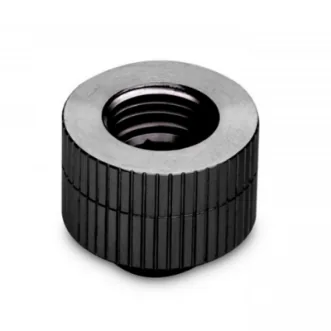
The LC coating developed for fasteners is an organic polymer composite dry-film coating and belongs to a completely different technical family from hard vacuum DLC coatings. It is applied by spray or dip impregnation and cured at low temperature, giving an extremely thin, uniform, strongly adherent film that does not change thread dimensions or assembly tolerances after application. It is the multi-functional insulating, lubricating and anti-corrosion coating of choice for fasteners in new energy, precision electromechanical and automation equipment, and is particularly suited to precision connections that require electrical isolation, leakage protection and eddy-current suppression.
Core advantages of LC coating: insulation as the primary function, combined with torque stability, corrosion protection, high compatibility and cost-effectiveness.
- Excellent electrical isolation: once cured, the coating forms a dense, stable inert organic dry film with consistent insulation resistance. It provides effective electrical isolation between the fastener and the joined part, eliminating leakage, eddy currents and stray current, avoiding the conduction risk created by direct metal-to-metal contact, and is a perfect match for the insulated assembly requirements of new energy and precision electronic control equipment.
- Precision torque stability and high assembly consistency: the coating has inherent high-quality dry-film lubrication, allowing the thread friction coefficient to be controlled precisely. This greatly narrows torque scatter across a production batch, solving problems such as stalling, galling and unstable torque during screw assembly, and safeguarding the accuracy and consistency of high-volume automated assembly.
- Strong corrosion protection and weather resistance for complex conditions: the dense, chemically inert film blocks salt spray, moisture, humid air and mild acid or alkaline media, providing stable corrosion protection and extending component service life.
- Low-temperature, safe process with no damage to high-strength substrates: curing takes place at low temperature throughout, with no hydrogen embrittlement risk, no substrate distortion and no material damage. It is fully compatible with 10.9 and 12.9 grade high-strength fasteners without impairing base metal mechanical properties, suiting all kinds of precision high-strength joints.
Overall, the LC coating combines four core functions - electrical insulation, precise torque stability, long-term corrosion protection and no substrate damage - in one coating with a very high cost-performance ratio, making it the general-purpose coating of choice for precision insulated connections.
Process limitations: it is an organic flexible dry-film coating with relatively low surface hardness. Its extreme wear resistance, heat resistance and resistance to high-intensity friction do not match hard vacuum coatings such as DLC and PVD, so it is not suitable for prolonged high-intensity reciprocating friction or extreme high-temperature conditions. Its strength is the general field of insulation plus precision assembly.
Core applications: mid-to-high-end precision assembly where electrical isolation is required, mainly fasteners for new energy battery connections, new energy electronic control structural parts, precision electromechanical equipment, automation control equipment, insulating screws for precision moulds and automotive precision electrical structural parts - a perfect match for precision connections that need leakage protection, eddy-current suppression, stable torque and moderate corrosion protection.
2. DLC coating (hard vacuum carbon film: ultra-high wear resistance, low friction)
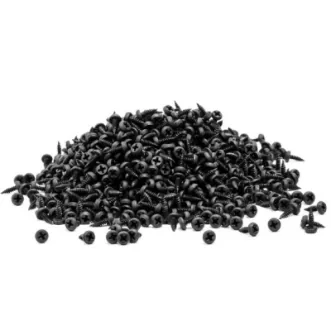
DLC stands for diamond-like carbon coating. It is a vacuum-deposited hard carbon film (falling under the broad PVD vacuum coating category, but with independent performance and a high-end positioning), built from high-purity carbon in a composite diamond and graphite microstructure. It is the top-tier wear-resistant and lubricating coating of the fastener industry and has no family relationship with the organic LC coating.
DLC coating offers three core characteristics: ultra-high hardness, ultra-low friction and extremely strong chemical inertness. Its hardness far exceeds that of conventional electroplating and ordinary PVD metal-ceramic coatings, giving excellent wear resistance. The friction coefficient is extremely low, enabling oil-free self-lubrication and completely eliminating the thread galling and wear scuffing caused by long-term reciprocating friction. The film is dense and stable, resistant to acids, alkalis, salt spray and ageing, delivering the highest combined level of corrosion protection, wear resistance and lubrication. The low-temperature vacuum process produces no hydrogen embrittlement and does not impair the base metal strength of high-strength bolts.
Process limitations: high cost and long processing cycles; coating adhesion depends on a transition layer and thickness is limited; the upper service temperature is limited, so it is not suitable for continuous ultra-high-temperature conditions.
Applications: high-end precision power transmission threads, precision fasteners in reciprocating motion, core components of premium automobiles, precision instruments, and wear-prone joints that are frequently assembled and disassembled.
3. PVD coating (physical vapour deposition: superhard precision wear-resistant film)
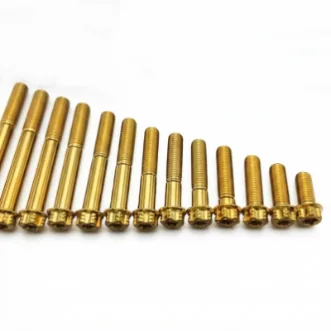
PVD stands for physical vapour deposition, a low-temperature vacuum physical coating process. Under vacuum, materials such as titanium, chromium and ceramic compounds are vaporised and ion-bombarded onto the workpiece surface to form a nanoscale hard film; typical materials are titanium nitride and titanium carbide. The process is environmentally friendly and leaves no chemical residue.
Its core advantages are an ultra-thin, invisible film, ultra-high hardness, high wear resistance and low-temperature processing without distortion. The coating is only a few microns thick and does not affect thread fit accuracy. Wear resistance far exceeds conventional electroplating, oxidation resistance and anti-seizure performance are excellent, and the film adheres strongly without flaking or peeling. Processing temperature is low, so base metal mechanical properties are preserved and there is no hydrogen embrittlement risk.
Process limitations: heat resistance and resistance to severe corrosion are weaker than CVD, and suitability for heavy-duty extreme conditions is limited.
Applications: screws for precision moulds, fasteners for high-end machine tools, miniature aerospace connectors and precision thread pairs under long-term reciprocating friction - mid-to-high-end applications that demand high accuracy, wear resistance and a clean appearance.
4. CVD coating (chemical vapour deposition: heavy-duty, heat- and corrosion-resistant hard coating)
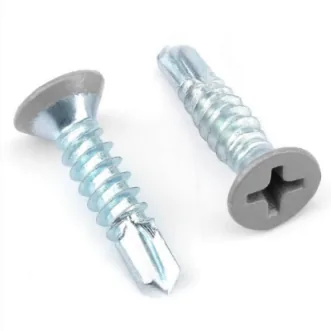
CVD stands for chemical vapour deposition, a high-temperature vacuum chemical reaction coating process. Unlike physical PVD deposition, CVD generates a dense hard compound coating on the fastener surface through a high-temperature chemical reaction of gaseous precursors, and can uniformly cover deep holes, irregular threads and recessed areas.
CVD coating is at the top level of mainstream processes for hardness, heat resistance, erosion resistance and resistance to acid and alkaline corrosion. It withstands long-term high-temperature oxidation and aggressive media, and its film density and structural stability are extremely high, making it suitable for heavy-duty extreme conditions.
Process limitations: the process temperature is very high, so 10.9 and 12.9 grade high-strength bolts must be used with caution, as base metal tempering and loss of strength can occur; cost is high and lead times are long.
Applications: high-temperature engine fasteners, turbine equipment, heavy-duty chemical machinery and high-temperature furnace connections - extreme conditions of high temperature, heavy load and severe corrosion.
5. Pre-applied adhesive coating (locking and sealing)
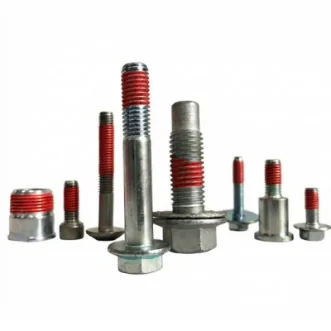
Pre-applied adhesive is a functional coating pre-applied to the fastener. Unlike anti-corrosion or wear-resistant coatings, its core functions are thread locking and sealing against leakage. An anaerobic adhesive or sealant is pre-coated on the thread surface and cured into a film that remains stable in storage at room temperature; when the joint is tightened, the film is activated and cures to lock the thread.
Its advantages are that no adhesive has to be applied on site, assembly efficiency is high, and locking and sealing are integrated in one step. It resists loosening under high-frequency equipment vibration and fills thread clearance to seal against water, oil and dust. Both removable and permanent-locking versions are available to suit different maintenance requirements.
Process limitations: the product has a storage shelf life, the adhesive layer can fail under high temperature or severe corrosion, and it offers no wear or corrosion protection.
Applications: fasteners for automotive chassis, household appliances, hydraulic lines and equipment subject to vibration; it is the standardised industrial anti-loosening solution.
6. Zinc-aluminium coating (Dacromet / chrome-free Dacromet: long-term protection for high-strength parts)
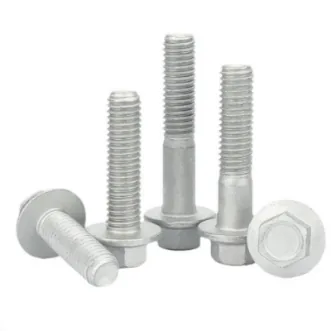
Zinc-aluminium coating, commonly known as Dacromet, comes in a traditional and an environmentally friendly chrome-free version. It is an electrolysis-free composite anti-corrosion coating dedicated to high-strength bolts: lamellar zinc and aluminium powder are combined with additives, sprayed and cured to form a dense protective film.
Its greatest advantage is the complete absence of hydrogen embrittlement risk, which fundamentally removes the danger of hydrogen-induced fracture in electroplated high-strength bolts and makes it an essential process for high-strength fasteners. Salt spray performance is excellent (500-1500 h), weather resistance is good and white rusting is unlikely, so service life far exceeds that of conventional zinc plating; the chrome-free version meets export environmental standards.
Process limitations: the coating surface is relatively soft and wear resistance is only moderate, so it is not suitable for frictional reciprocating conditions; surface conductivity is also only moderate.
Applications: 10.9 and 12.9 grade high-strength bolts, wind power equipment, photovoltaic mounting structures, outdoor steel structures and exposed chassis fasteners - the mainstream process for long-term corrosion protection of heavy-duty outdoor assemblies.
7. Zinc-nickel electroplating (trivalent chromium sealing: high-end corrosion protection for new energy)
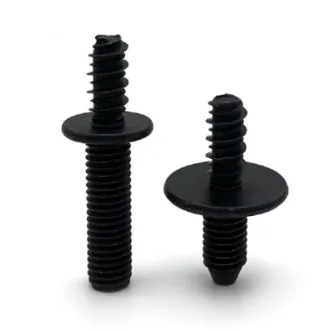
Zinc-nickel alloy electroplating with trivalent chromium passivation and sealing is currently the mainstream high-end environmentally friendly electroplating process in industry. A zinc-nickel alloy layer is deposited electrochemically and then passivated and sealed with trivalent chromium, creating a two-layer corrosion protection system and eliminating the pollution problems of conventional hexavalent chromium.
The coating is dense, uniform and strongly adherent. Corrosion resistance is 4-8 times that of conventional zinc plating, salt spray can exceed 700 h, low-temperature performance is stable, hydrogen embrittlement risk is controllable and thread accuracy is good, making it suitable for precision exposed fasteners. It is the standard corrosion protection process of the new energy industry.
Process limitations: it does not tolerate high temperature - discolouration and loss of corrosion protection occur in hot environments - and it is not suitable for wear or conductive applications.
Applications: new energy vehicle battery packs, exposed body screws, automotive precision fasteners and connectors for outdoor precision equipment.
8. PTFE composite coating (low friction, anti-seize, anti-stick, corrosion resistant)
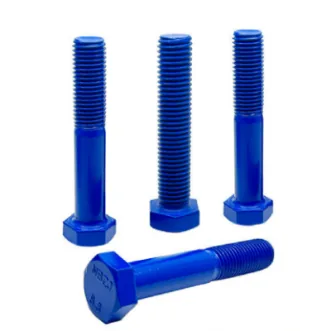
The PTFE composite coating is an organic dry-film lubricating and anti-corrosion coating formed by spraying followed by high-temperature sintering. It has extremely low surface energy and excellent self-lubricating properties, and is the general industrial coating for anti-seizure, anti-stick and corrosion resistance.
Core advantages: the friction coefficient is extremely low, completely solving thread galling and assembly stalling and allowing repeated disassembly and reassembly; it resists acids, alkalis, solvents and ageing, repels water and moisture, and keeps assembly torque highly stable, giving it very broad compatibility.
Process limitations: hardness is not high, wear resistance is only moderate, and the coating carbonises and fails under ultra-high temperature.
Applications: new energy motor lines, chemical equipment, precision sealing connectors, thread pairs requiring repeated disassembly and fasteners in corrosion-resistant, anti-stick conditions.
9. Graphite lubricating coating (conductive lubrication: anti-seizure for high temperature)
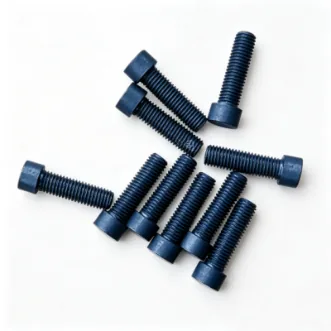
Graphite lubricating coating is a functional cured coating based on high-purity graphite. It is one of the few fastener coatings that simultaneously provides high electrical conductivity, self-lubrication and high-temperature anti-seizure, and differs from ordinary lubricating coatings.
The coating has low electrical resistance and stable conductivity, keeping electrical connections reliable and preventing overheating and oxidation. Lubricity is excellent, the friction coefficient is low and anti-seizure capability is strong, effectively preventing thread seizure under high temperature and high torque - a key process for heavy industry, power and high-temperature equipment.
Process limitations: corrosion protection is only moderate; the main functions are lubrication and conduction, so it is not used as a primary anti-corrosion coating.
Applications: high-voltage electrical equipment, power terminals, conductive connection fasteners, wind power high-strength bolts and high-temperature pipeline connectors - conductive lubrication, high-torque anti-seizure and high-temperature anti-seizure conditions.
Conclusion
The nine mainstream special coatings for fasteners each serve a specific purpose and match different industrial conditions: the organic LC coating focuses on general precision assembly, torque stability and cost-effectiveness; DLC diamond-like carbon focuses on ultra-high wear resistance, ultra-low friction and high-end precision durability; PVD and CVD respectively suit precision wear resistance and extreme high-temperature, heavy-duty wear resistance; pre-applied adhesive concentrates on locking and sealing under vibration; zinc-aluminium and zinc-nickel are the two core corrosion protection solutions for high-strength and new energy parts; PTFE specialises in low friction, anti-stick and corrosion resistance; and the graphite coating is the dedicated solution for conduction and high-temperature anti-seizure. In practice, matching the process to working temperature, corrosive environment, assembly accuracy and locking or wear requirements will fundamentally improve connection stability and safety as well as the service life of the whole machine.